Our Next Chapter of Communications Intelligence Is Open, Agentic, and Built for Your Enterprise
Today, we’re taking an important step in the evolution of Smarsh — and in the evolution of communications intelligence itself.
For more than 20 years, our industry has focused on capturing and storing communications for compliance. That work remains essential. But the way financial institutions create value from communications data is changing quickly.
The archive can no longer be treated as a place where data goes to sit. It needs to become an intelligent, governed foundation that helps teams search, investigate, supervise, understand, and act — across every channel and every workflow. It needs to work with the tools and AI models an organization already uses. And it needs to do all of that without compromising control, privacy, auditability, or defensibility.
That’s why today we’re introducing the next phase of our Communications Intelligence Platform: an open, composable, agentic-ready intelligence layer for the enterprise, that helps authorized teams securely search, investigate, supervise, understand, and act on communications data across enterprise tools and workflows.
The launch includes six new capabilities
- AskSmarsh AI
- MySearch Agent
- Discovery Agent Investigation
- New non-financial misconduct models for Intelligent Agent
- Smarsh MCP Server
- New Capture integrations, including Amazon Bedrock, Google Workspace, and Anthropic Claude
Together, these capabilities help you gain more value from communications data without compromising control, privacy, auditability, or defensibility.
For more than 20 years, our industry has focused on capturing and storing communications for compliance. That work remains essential. But as communications expand across channels and AI changes how teams work, the archive can no longer be treated as a place where data simply sits.
It needs to become an intelligent, governed foundation that works with the enterprise tools and AI models you already use.
From disconnected data journeys to one governed intelligence layer
The time to unify is here. For years many Compliance teams in our industry used one system to capture email. Another to handle mobile messages. A separate platform to support surveillance or eDiscovery. New channels required new connectors, contracts, interfaces, and operating procedures. The result, is often a collection of vendor silos that were never designed to work together.
The problem isn’t simply that this creates a complicated architecture. It creates operational risk.
Every manual handoff is another place where context can be lost. Every export is another copy of sensitive data to manage. Every point integration is another control to maintain. And every new regulatory requirement can trigger another procurement and implementation cycle.
The real data journey is much broader than “capture and archive.” It is:
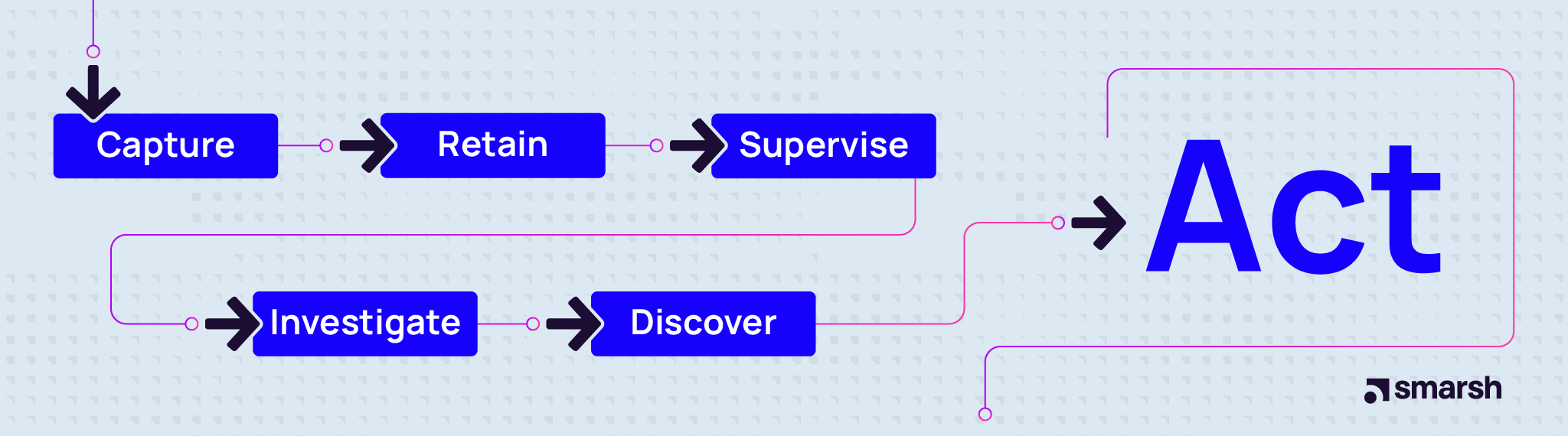
The opportunity is to connect that journey so that data and workstreams can move intelligently across it.
That is the role of the agentic intelligence layer we’re building at Smarsh: a governed foundation where authorized AI agents and applications can securely query communications data, understand its context, and take action within defined controls.
What agentic means in a regulated environment
There’s a lot of excitement around AI agents, but enterprise leaders are right to ask harder questions:
- What data can an agent access?
- How is identity enforced?
- What actions can it take?
- Can those actions be reviewed later?
- Is the reasoning traceable?
- Can the result stand up to an audit, regulatory exam, or legal challenge?
For a financial institution, agentic cannot mean uncontrolled autonomy. It should mean useful automation within a clearly governed operating model.
That’s the principle behind Smarsh’s agentic access layer.
We’re making communications intelligence available through open APIs and the Model Context Protocol, or MCP. This allows authorized AI agents and enterprise tools to access Smarsh intelligence without requiring users to move between applications, learn specialized query syntax, or copy sensitive information into another system.
The goal is not to replace governance with AI. It is to make governance work at the speed and scale of AI.
Every access request, agent-driven action, and AI-assisted answer should be subject to the same enterprise expectations as any other sensitive workflow: identity-aware permissions, transparent logic, audit trails, and defensible chain of custody.
AskSmarsh AI is making connecting compliance workflows easy
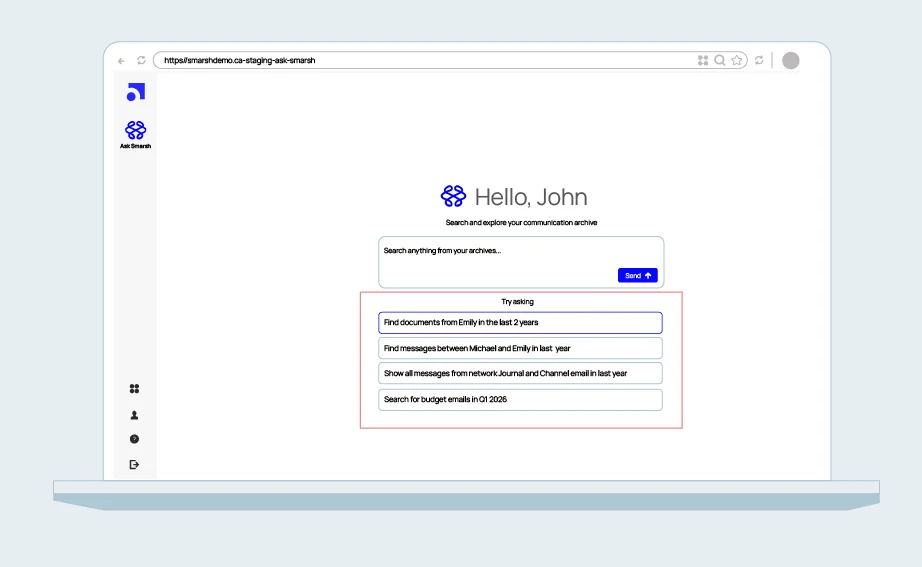
One of the most visible ways customers will experience this shift is through AskSmarsh AI.
AskSmarsh AI lets users search, investigate, and generate reports across captured communications using ordinary language. There’s no need to learn Lucene syntax or understand the underlying query structure before getting started.
A compliance professional might ask:
“Show me conversations involving this employee and their external contacts during the week before the trade was executed.”
A legal team might ask:
“Find communications related to this matter across email, chat, mobile, and voice, and summarize the key timeline.”
AskSmarsh AI translates natural-language intent into a precise, identity-aware search across channels. The resulting query logic remains transparent and editable, so teams can understand what was searched and why.
That transparency matters. In regulated environments, the answer is only part of the outcome. Teams also need to explain how they arrived at it.
AskSmarsh AI also helps reduce the friction around multilingual investigations, with on-demand translation across more than 14 languages and voice transcription capabilities that bring additional context into the same workflow.
The value is straightforward: less time assembling evidence and more time interpreting what it means.
MySearch Agent is turning the archive into a shared enterprise resource
We’re also introducing MySearch Agent, which gives authorized employees secure, self-service access to their own archived communications.
This might sound simple, but it addresses a persistent enterprise challenge. Employees often need to recover an old email, locate an attachment, or find information from a prior conversation. Today, that can mean opening an IT ticket or asking a compliance team to search on their behalf.
MySearch Agent provides a governed alternative.
Employees can search across their archived email, chat, voice, mobile, and social communications without creating another manual request queue. They can recover deleted emails and attachments, find information during an Exchange or Microsoft 365 outage, and access institutional knowledge more efficiently.
For IT, this means fewer repetitive tickets and less operational overhead. For employees, it means faster access to information. For the organization, it means the archive becomes more than a compliance repository — it becomes a trusted resource for knowledge discovery and business continuity.
Discovery Agent is moving from export-first to investigation-first
Legal teams face a different but related challenge. Early case assessment often begins with a request to IT, followed by data collection, preparation, export, processing, and review in another platform. That process can take weeks before legal teams have enough context to decide how to proceed.
Discovery Agent is designed to change that sequence.
Legal teams can conduct early case assessment directly against the governed communications archive, without first exporting everything into an outside platform. Its patent-pending Semantic Context Graph helps connect people, conversations, topics, and events. Investigation playbooks support automated timeline reconstruction and help teams focus on the communications that matter.
When an export is necessary, the objective is a right-sized matter data set — not a massive, expensive collection of everything potentially relevant. Chain of custody remains intact throughout the process.
That can help legal teams make better decisions earlier, reduce unnecessary outside counsel costs, and respond to matters with greater confidence.
Intelligent Agent is expanding supervision beyond traditional risks
Our Intelligent Agent continues to help compliance teams automate supervision and surveillance workflows. As part of today’s launch, we’re adding three new non-financial misconduct models focused on:
- Hostile, Abusive and Discriminatory Language
- Sexual Harassment
- Intent to Resign
These are important signals, but they are also highly contextual. A single phrase rarely tells the whole story. The ability to analyze communications across channels — and preserve the surrounding context — is critical to reducing false positives and identifying meaningful risk.
Agentic workflows can help compliance teams move from reviewing every possible signal manually to focusing human expertise where it has the greatest impact.
That distinction is important. The future of compliance is not “AI instead of people.” It is people equipped with better context, better prioritization, and better tools for judgment.
These three new NFM models join our existing 7 models to deliver one unified view of risk:
- Secrecy & Concealment
- Conflicts of Interest
- Rumor & Speculation
- Quid Pro Quo
- Market Manipulation
- Gifts & Entertainment
- Customer Complaints
- Hostile, Abusive and Discriminatory Language
- Sexual Harassment
- Intent to Resign
Built for the architecture you have and the one you’re building
We know large financial institutions are not starting from a blank sheet of paper. You already have investments in cloud platforms, data warehouses, AI services, identity systems, security tooling, and internal applications.
That’s why we’re building Smarsh as an open and composable platform.
Customers can:
- Use the AskSmarsh AI experience directly
- Extend Smarsh with their own workflows and integrations
- Embed governed communications intelligence into their own applications and AI stack
Through APIs, MCP, and support for emerging AI surfaces — including Anthropic Claude, Amazon Bedrock, and Google Workspace — customers can bring their own models and connect Smarsh intelligence to the broader enterprise ecosystem.
This is a different philosophy from the traditional “log in to one application and search one archive” model.
We believe communications intelligence should be available wherever authorized teams work, without forcing customers to abandon their existing architecture or duplicate sensitive data across dozens of systems.
The outcomes that matter
For IT leaders, this means a simpler and more extensible data foundation:
- One governed layer across all communications data
- Fewer point integrations and manual handoffs
- Faster onboarding of new channels and use cases
- Open access through APIs and MCP
- Auditable actions and defensible data handling
- Infrastructure designed for AI consumption at enterprise scale
For legal and compliance teams, it means faster answers with more context:
- Investigations that begin directly in the unified archive
- Fewer exports and less data duplication
- More self-service and less dependency on IT
- Better visibility across channels
- Automated workflows with human oversight
- Defensible results that can stand up to scrutiny
The broader opportunity is even bigger. Once communications data is complete, governed, and accessible, it can support more than compliance and legal workflows. It can help organizations understand institutional knowledge, improve business continuity, support employee and customer insights, and create new sources of competitive advantage.
A platform for the next generation of enterprise AI
Across the technology industry, the conversation is shifting from software as a destination to software as an intelligent service — where systems do more of the work and deliver measurable outcomes.
That shift is coming to communications intelligence.
The platforms that matter in the next decade will not simply hold data. Or help you just meet regulations. They will make trusted data available to the people, agents, and applications that need it — within the controls that enterprises require.
That is the direction we’re taking with Smarsh.
Today’s launch is not the end state. It is the next step toward a fully headless, governed communications intelligence layer that customers can build on, extend, and make their own.
I’m excited about what this means for our customers — not just because the technology is powerful, but because it addresses a problem I hear from technology leaders every day: how to make critical enterprise data more useful without making the risk surface larger.
The future is open. It is composable. It is agentic.
And with Smarsh, communications intelligence is ready to become an active, governed part of the enterprise — not just an archive in the background.
Learn more about the Smarsh Communications Intelligence Platform.
Share this post!

Smarsh Blog
Our internal subject matter experts and our network of external industry experts are featured with insights into the technology and industry trends that affect your electronic communications compliance initiatives. Sign up to benefit from their deep understanding, tips and best practices regarding how your company can manage compliance risk while unlocking the business value of your communications data.
Ready to enable compliant productivity?
Join the 6,500+ customers using Smarsh to drive their business forward.

More Resources






Subscribe to the Smarsh Blog Digest
Subscribe to receive a monthly digest of articles exploring regulatory updates, news, trends and best practices in electronic communications capture and archiving.
Smarsh handles information you submit to Smarsh in accordance with its Privacy Policy. By clicking "submit", you consent to Smarsh processing your information and storing it in accordance with the Privacy Policy and agree to receive communications from Smarsh and its third-party partners regarding products and services that may be of interest to you. You may withdraw your consent at any time by emailing [email protected].
FOLLOW US